Hospitals move AI beyond testing to wider clinical implementation
The tech expands across workflows to automate documentation and patient services.
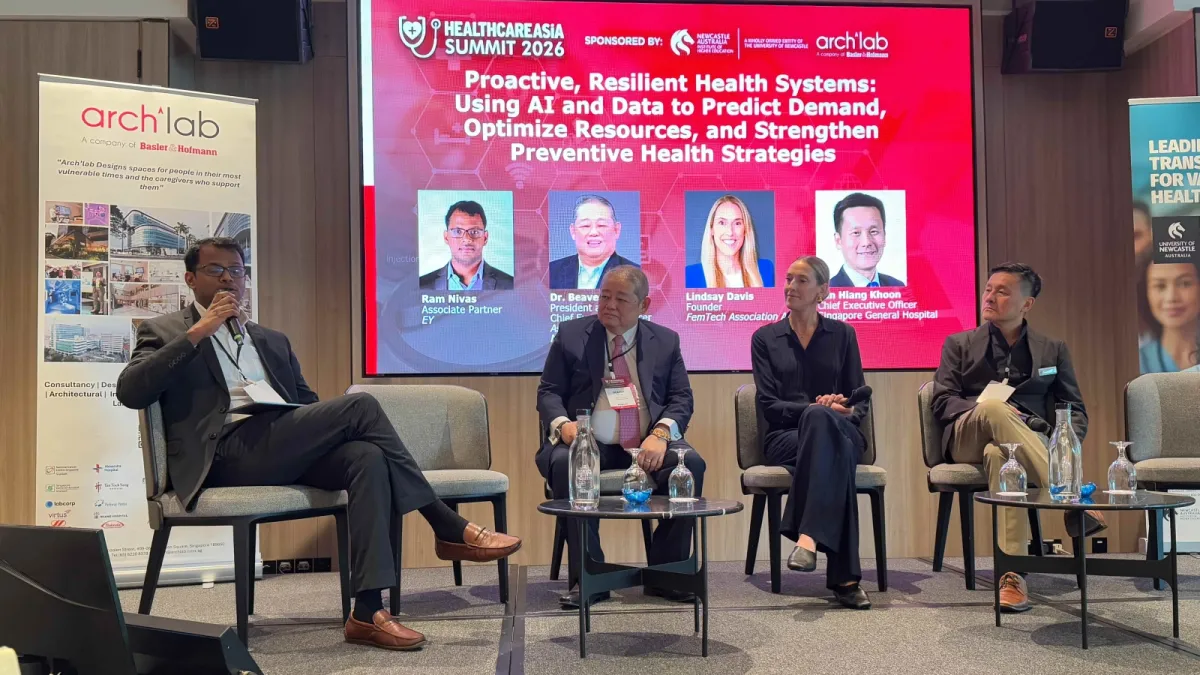
Hospitals are expanding the use of artificial intelligence (AI) across clinical workflows and patient services, with some initiatives moving beyond early testing to wider implementation, industry leaders told the Healthcare Asia Summit in Singapore.
Hiang Khoon Tan, CEO of Singapore General Hospital (SGH), said the hospital has rolled out an ambient tool, known as ‘note buddy’, to assist with clinical documentation during consultations.
“A lot of the conversation in a clinical setting is important for building rapport between the physician and the patient,” Tan said. “These are important social exchanges, but they don’t necessarily have clinical relevance.”
He noted that natural language processing (NLP) AI can automatically record and summarise consultations into clinically relevant notes, allowing doctors to focus more on patients rather than screens.
Furthermore, SGH is working with Singapore’s Ministry of Health to scale AI use in population health, including for early dementia screening.
Beaver Tamesis, president and ceo at Asian Hospital and Medical Center, said AI is already supporting decision-making in some settings.
The hospital is developing AI-powered patient engagement tools to address access issues, such as difficulty reaching hospitals through traditional channels.
These chats lead to patients getting what they want—be it information, an appointment, or safely accessing all their results, Tamesis said.
He added that AI is also being used to support faster interpretation of diagnostic tests, including radiology and EKGs, to reduce turnaround times. “Hopefully, within just an hour, we can give the patient back the results.”
However, scaling the solution across entire organisations remains difficult, particularly due to differences in workforce readiness.
Resistance also persists amongst some professionals concerned about the impact of automation on their roles.
Tamesis pointed out that strong governance frameworks are needed to ensure AI supports rather than replaces clinicians, with doctors remaining the final decision-makers in patient care.
“I think we can protect both our doctors and, at the same time, improve the quality,” he added.
Tan said broader structural pressures are accelerating the need for scalable AI solutions, including ageing populations, rising chronic disease burdens, and manpower shortages.
“If you look at what technology can do, the most valuable will be those that can solve these problems,” he said.
However, implementation challenges remain, particularly in talent and organisational structure. “You need a team of workers who understand the humanistic side of things—human behaviour, implementation science, change management, and communication.”
Women’s health
Meanwhile, Lindsay Davis, founder of FemTech Association Asia, said AI adoption in the femtech sector is already gaining traction globally, particularly in the areas of oncology, pregnancy and fertility.
“I think many opportunities are emerging with ageing and healthy ageing, particularly when considering our consumers are going through their midlife and menopausal stage,” Davis told the panel.
She said one key focus for femtech firms is building more diverse and less biased datasets, often developed directly by companies to better reflect women’s health needs.
She pointed to wearable devices such as the ‘Oura Ring’. “They just released a women's health side to their ring, and it's non-dismissive and empathetic.”
However, she said the sector’s startups continue to face structural challenges, particularly in funding and access to reliable information channels.
Globally, only about 2% of venture capital (VC) funding goes to women founders, whilst around 75% of decision-makers in Southeast Asian VC firms are male.
“We're over 80% women founders,” she added.
Moreover, over half (52%) of women in Southeast Asia are hesitant to openly discuss their healthcare needs due to fear of judgment, according to the June 2024 FemTech Association Asia & Milieu Insight report, ‘Insights into the Femtech Landscape in Southeast Asia.’
Despite these constraints, Davis said partnerships with insurers and corporates are expanding the role of femtech in healthcare ecosystems.











 Read Here
 Advertise
 Sign Up