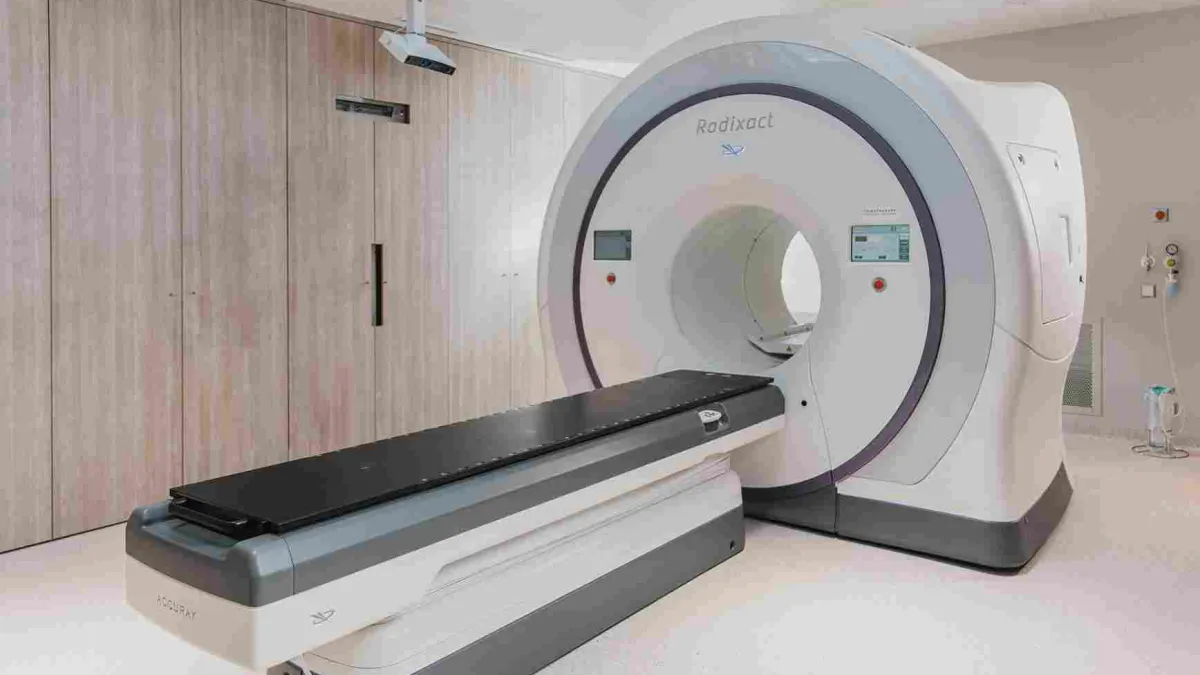
Hospital demand and AI drive $10b expansion in MRI market in 2036
Hospitals are investing in AI reconstruction to improve scanner utilisation.
The global magnetic resonance imaging (MRI) market will grow to $10.2b by 2036 from $7.0b in 2026, at a compound annual growth rate (CAGR) of 4.2%, according to Future Market Insights (FMI).
Amongst major economies, China and India are forecast to post CAGRs of 5.3% and 4.9%, respectively, through 2036.
Growth stems from rising hospital demand for imaging capacity, artificial intelligence (AI)-based image reconstruction, and wider adoption of low-helium MRI systems, the report said.
Hospitals seek shorter scan times and higher patient throughput as imaging volumes increase across neurology, oncology, musculoskeletal, and cardiovascular diagnostics.
Suppliers compete on scan efficiency, image quality, magnet technology, and service support as procurement shifts towards operational performance.
"MRI buying is becoming a capacity decision for hospitals," said Anurag Sharma, analyst at FMI. "Radiology leaders want shorter scan slots and fewer repeat scans."
Lower magnet siting risk is also becoming a purchasing factor, Sharma said, with hospitals favouring suppliers offering proven coils and reliable service networks for new facilities and replacement cycles.
AI-based reconstruction reduces scan time, improves image quality, decreases repeat examinations, and boosts scanner utilisation.
Low-helium and helium-free systems reduce installation complexity and maintenance requirements.
Portable MRI is an emerging segment for critical care and intensive care use, the report found.
By strength, 1.5T systems hold 46.0% of market share in 2026; by architecture, closed-bore MRI accounts for 64.2%.
Fixed MRI represents 92.0% of the market by modality, whilst clinical imaging accounts for 73.0% by application.
Hospitals hold 58.0% of the care-setting share, whilst academic institutes hold 58.0% of the research-setting share, driven by neuroscience and imaging research.
High capital costs, service requirements, and infrastructure constraints remain key challenges, with systems requiring shielding, cooling infrastructure, and specialised staff.
Competition hinges on image quality, AI capability, magnet efficiency, service uptime, and installation flexibility.
AI reconstruction, low-helium systems, portable MRI adoption, and faster scan workflows will shape the market over the forecast period.



















 Read Here
 Advertise
 Sign Up