Singapore‑German partnership advances corneal nerve research
The partnership brings large-area corneal nerve imaging into clinical research.
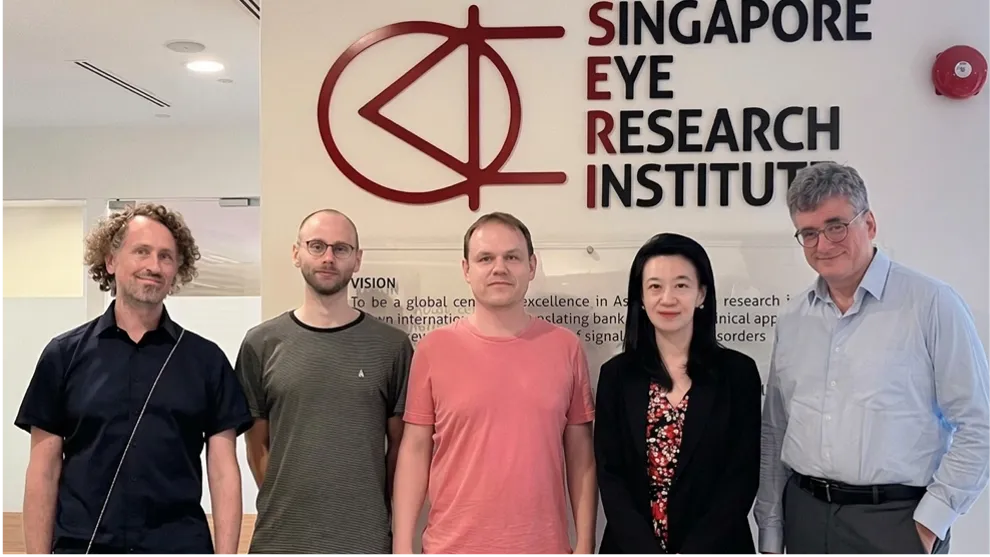
The Singapore Eye Research Institute (SERI) and the Singapore National Eye Centre (SNEC) have partnered with German research institutions to bring a next-generation corneal nerve imaging platform into clinical research.
The platform can visualise the corneal subbasal nerve plexus across an area approximately 60 times larger than conventional in vivo confocal microscopy, allowing researchers to obtain a more comprehensive assessment of corneal nerve architecture.
The collaboration brings together SERI, SNEC, and German partners from Rostock University Medical Center, Rostock University and Karlsruhe Institute of Technology (KIT). It is supported by Heidelberg Engineering GmbH.
Scientists and engineers in Rostock and Karlsruhe jointly developed the platform over more than a decade.
SERI and SNEC will lead its clinical implementation and validation, with Associate Professor Yu-Chi Liu, Clinician Scientist at SNEC's Corneal & External Eye Disease Department, leading its integration into ongoing and future clinical studies.
The platform combines a modified Rostock Cornea Module with automated eye guidance, intelligent image acquisition and large-area image mosaicking to provide cellular-resolution images of the corneal subbasal nerve plexus.
It also supports quantitative analysis of resident immune cells.
The cornea contains the highest density of sensory nerves in the human body, making it a non-invasive window into ocular and systemic neurological and immune-mediated diseases.
Researchers can use the platform to investigate diabetic neuropathy, dry eye disease, neurotrophic keratopathy, peripheral neuropathies, neurodegenerative disorders, and inflammatory ocular surface diseases.
Around 8.5% of Singaporeans aged 28 to 74 have diabetes, and up to 50% of them may develop diabetic neuropathy.
Dry eye disease affects about 10% of Singaporeans, with prevalence potentially increasing as the population ages and screen use rises.
The platform is expected to support longitudinal disease monitoring, assessments of treatment response, and the development of imaging biomarkers for clinical studies.
Researchers will also explore quantitative image analysis, artificial intelligence-assisted image evaluation, and multimodal ophthalmic imaging.
The platform was installed at SERI in July 2026, with the original development team conducting technology transfer and on-site training.
The team includes Dr Stephan Allgeier from KIT, alongside Professor Oliver Stachs, Dr Karsten Sperlich, and Dr Sebastian Bohn from the Department of Ophthalmology at Rostock University Medical Center, led by Professor Thomas A. Fuchsluger.
Following technical validation, the platform will become part of SERI's clinical imaging infrastructure and support collaborative research programmes.













 Read Here
 Advertise
 Sign Up