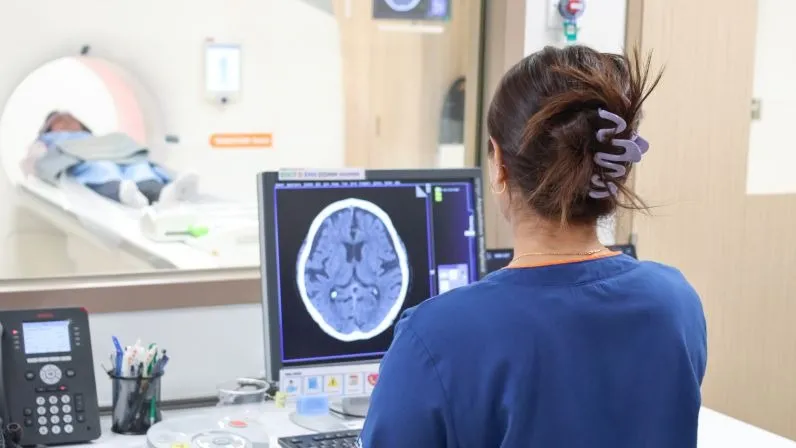
Singapore General Hospital uses AI to speed up brain bleed detection
It processes about 50 head scans daily, with 10% showing acute bleeding.
Singapore General Hospital Pte. Ltd. (SGH) has cut the time needed to report suspected brain bleeding on CT scans to less than 30 minutes from as long as an hour using artificial intelligence (AI), letting doctors make treatment decisions sooner.
“Radiologists can now complete reporting in under 30 minutes, compared with 30 minutes to an hour without AI,” Sarat Kumar Sanamandra, a senior consultant in the Department of Neuroradiology at SGH and the National Neuroscience Institute, said in an emailed reply to questions.
The AI software, called iScreen, gives radiologists a preliminary assessment within six minutes and alerts them by text message when it detects possible bleeding.
The system runs on AimSG, a platform developed by Singapore's national health technology agency Synapxe Pte. Ltd.
The state-owned hospital performs about 50 head CT scans daily, equivalent to roughly 18,000 annually, Sanamandra said. About 10% reveal acute bleeding inside the skull, a potentially life-threatening emergency.
The software allows doctors to receive critical findings before radiologists complete their final reports, potentially speeding up treatment decisions.
Sanamandra said the hospital has measured the system's accuracy, reporting times, and adoption but has yet to assess whether faster reporting improves patient outcomes.
The software underwent testing using actual patient scans without influencing clinical decisions before deployment, consistently demonstrating high accuracy, he said.
Radiologists remain responsible for reviewing the results, whilst healthcare professionals and institutions retain responsibility for patient care.
A spokesperson for Synapxe said it plans to expand the use of clinically tested AI tools for medical imaging across Singapore's public healthcare system.
“Synapxe will continue working with public healthcare clusters on the cost-effective scaling of clinically validated AI models in medical imaging across the public system,” he added.
The spokesperson said more public healthcare institutions are expected to join AimSG this year, with more AI applications planned.














 Read Here
 Advertise
 Sign Up